For decades, sports marketing has been built on access: leagues, teams, talent, and live moments. That model still drives scale, but it no longer reflects how fans actually engage with sports.
They don’t just watch anymore. They participate, simulate, and manage the game themselves. Sports simulation titles like EA SPORTS College Football represent a new layer of fan engagement: persistent, interactive, deeply immersive and always on.
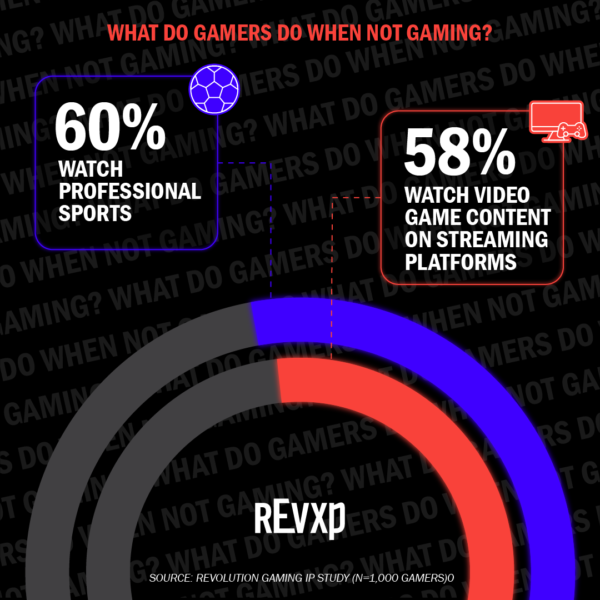
A recent REVXP survey focused on gamers showcased a substantial crossover between watching sports and watching video game content.
Brands tapping into sports games isn’t a new trend, but Chipotle’s recent partnerships with EA SPORTS College Football and PGA TOUR 2K franchises reflect a larger strategic shift: from buying media in sports games to becoming part of how players experience them.
ENGAGEMENT HAS SHIFTED FROM MOMENTS TO HOURS
Traditional sports are built around fixed windows of attention. While leagues like the NFL have attempted to become year-round properties, fan engagement peaks around key calendar windows such as the regular season, playoffs and Super Bowl. Conversely, sports simulation games create continuous engagement cycles. The season never truly ends in Madden, and there are still Dynasties to create, another franchise to build and, yes, there is still a chance for the Jets to win the Super Bowl.
This is the core difference: traditional sports drive moment-based attention, while sport simulation games drive sustained engagement.
THE SIMULATION FAN IS MORE VALUABLE
Simulation players don’t just watch the game. They actively manage teams, build rosters, make strategic decisions, creating deeper emotional investment and stronger opportunities for brands.
Gaming environments generate higher brand recall, stronger affinity, and greater purchase intent. Globally, gaming now reaches over 3.6 billion players, which represents 61.5% of the global online population. * Gaming has become one of the largest attention platforms available to brands.
Unlike traditional sports calendars, the season never ends with sports games. Engagement opportunities span gameplay, streaming, and creator-led content environments.
This creates sustained exposure—not tied to game day, but part of players’ daily gaming experiences.
EA estimates players played the equivalent of 23,000 NFL seasons EVERY DAY in Madden! **
MORE EFFICIENT MEDIA MODEL
Traditional sports rights command premium prices due to scarcity and scale. Gaming offers a more efficient alternative, delivering lower cost per attentive impression and deeper engagement per user.
Brands are effectively accessing the same cultural territory, sports fandom, at a higher engagement density and more efficient cost base.
EA recently introduced its EA Advertising platform, designed to help brands connect with audiences through the EA SPORTS Partner Program. The program will see EA offer brand partnerships, gameplay integrations, ad units and enhanced targeting, giving marketers access to 120 million monthly players.
SAME PLAYBOOK, BETTER LEVERS
Simulation partnerships mirror traditional sports frameworks through IP, seasons and storytelling, but offer brands more control.
Brands can integrate into gameplay, participate in progression systems, and activate alongside creators who engage daily with audiences.
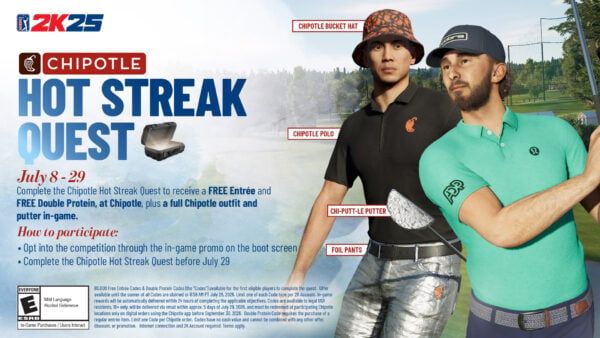
REVXP recently forged a partnership for Chipotle with 2K around PGA TOUR 2K25. Tied to the launch of the in-game season, the campaign rewarded players with coveted in-game branded cosmetics and real Chipotle food rewards as part of the Hot Streak Quest. Building on Chipotle’s existing partnership with the PGA Tour and PGA Tour Hot Streak Presented by Chipotle, the activation showed how game activations can be an extension of an existing league deal.
CONSIDERATION FOR BRANDS
When working with officially licensed sports simulation games like EA’s Madden or the NBA 2K franchise, it is important to understand parameters of working within those leagues’ commercial ecosystems. Opportunities for brands could be limited or nonexistent in categories where there are league partners.
In Chipotle’s case with EA SPORTS College Football, the brand utilized the game as a “way in” to engage with the college football fan at a macro level through in-game integrations, a buy / get offer during the College Football Playoff and PlayStation Tournament series along with its first-ever buy-one-get-one offer for in-restaurant guests wearing a college football jersey. By contrast, its PGA TOUR 2K25 activation leveraged the game as an extension of an existing relationship, reinforcing rather than replacing an established sponsorship.

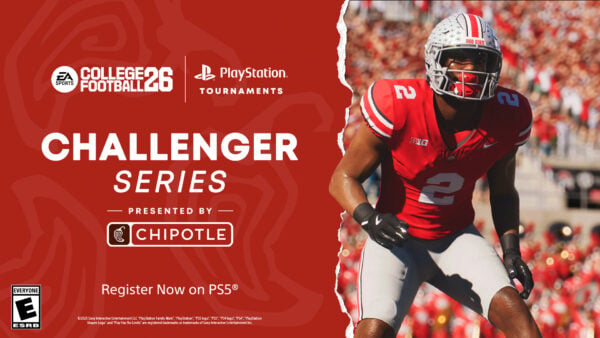
Chipotle had a variety of touch points in and around the EA SPORTS College Football ecosystem during the partnership. The brand leveraged its existing NIL partnership with Ohio State University and Caleb Downs for promotional materials around the EA SPORTS College Football campaign.
Additional consideration should be given around how to best reach specific game audiences. Sport simulation games rank low on Twitch live stream viewership, with EA FC 26 claiming the top spot in the category but 35th overall on the platform (Via TwitchTracker.com 7/7/26). Each game’s community differs but focusing on creator-led content across social platforms such as Instagram, TikTok, and YouTube is usually a more efficient and safer bet to engage the audience.
For brands looking to drive engagement, Chipotle hosted a month-long tournament series on PlayStation Tournaments that ran in parallel to the College Football Playoffs—creating engagement and rewarding competition during a marquee time on the CFB calendar.
The future of sports marketing isn’t just about owning moments. It’s about embedding brands into environments where fandom is experienced daily. Brands looking to enter a new sport ecosystem or reach highly engaged fans can do so through sports simulation games.
Brands should consider thinking beyond just buying in-game media and how the brand can meaningfully engage the player community through activations such as coveted in-game rewards and creator content. Buying presence in-game doesn’t equate to being relevant.
REVXP has a proven track record developing strategic integrations in-game. We work with our clients to show up meaningfully, driving value for players without being intrusive to their gaming experience. Game publishers trust REVXP to collaborate and our vision to balance achieving our clients’ goals with delivering value-added experiences for their players.
Sources:
*https://icon-era.com/statistics/video-game-statistics/
**https://www.ea.com/news/introducing-ea-advertising